Historically this engine type is an important and
rare example of a transitional design in wind engine
technology between the earlier annular sailed
windmills (such as Haverhill in Suffolk and
Owlesbury in Hampshire), of which no example
survives and the 20th Century fixed blade galvanised
wind engines (the "prairie type" wind pumps).
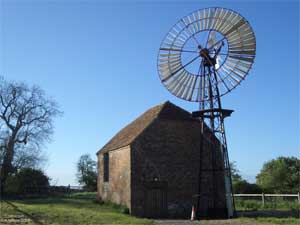
Crux Easton has a 20ft wind wheel on a 32ft
hexagonal skeletal steel tower, which originally
pumped water and ground corn. It has 48 canvas
sails, each of which is 5ft in length, and their
angle is adjustable to allow for variations in the
strength of the wind. A fan tail enables the engine
to turn into the wind.
The Crux
Easton Wind Engine is regularly
Open to the Public
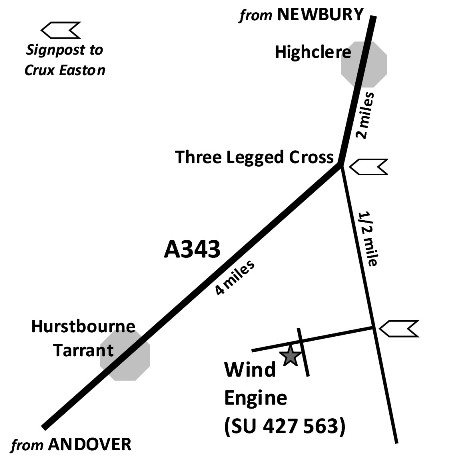
and is situated at OS Map ref: SU 425 564, one mile
off the A343 between Highclere and Hurstbourne
Tarrant.
The tower has had
to be extensively restored, as the original legs
were corroded and in danger of collapse. Much of the
wind wheel has also been restored, and where parts
were missing, cracked or broken these were re-cast
from the original components.
The well house predates the engine by about 100
years and contained the well with water being
brought up by a man wheel. When the engine was
erected a lean-to was built alongside which housed a
small barn thresher worked by the wind engine via an
exterior wheel. On the upper floor inside can
be seen a secondary inner wall built on two sides to
hold the bearing boxes for the shafting to run the
milling machinery.
Maps from the 19th Century show that the well
existed before the wind engine was built. In 1873 a
well is marked alongside a square pit (which could
have been the site of the manor that research
suggests was here up to the 18th Century). Twenty
one years later in 1894 the map shows a small circle
on the North side of the well to indicate the Wind
Engine.
After
construction in the 1890's the pumped water provided
via the wind engine supplied only the Manor House
and the farm for agricultural purposes. At the same
time, water from the Carnarvon Estate supplied four
other houses in the village.
During the excavation around the well house,
numerous pieces of broken bottles have been found
that date from the 18th Century, including some
identification seals bearing the name Ed. Lisle
Esq., the landowner here from 1678 -1722. Some of
these are on display in the well house.