Snippets
|
|
A collection of interesting
items to browse over. If you have something
for this page, please send it to us. |
 |
|
The International
Molinology Society or TIMS
assembles information about wind and
water mills across the world. HMG member
George Roussopoulos has analysed their extensive
database of mills and his results are shown here. |
 |
Henri de Portal :
extracts from “Highways and byways in Hampshire”
1908 about the man who founded a bank note
paper making company that supplies the Bank of
England to this day |
 |
|
Keeping the Millers honest : a notice
from Sussex in 1796 about the requirement to keep
accurate weights and measures |
 |
Macabre Tale
: A macabre tale of a murder and its
consequences which took place in 1804 at Fratton
Mill near Portsmouth. To see the full story
click here. |
 |
|
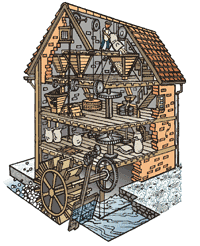
Superb cutaway diagrams of a
Water
Mill showing all the important parts.
|
 |
 |
|
The Miller
- an extract from
THE MILLER magazine 1867 |
 |
|
A
Brief History of Bread by Tony Yoward |
 |
|
A Potted History of
Hovis :
This
undated article is a short history
of
the firm at
Mill Street, Stone, Staffordshire
to 1918. |
 |
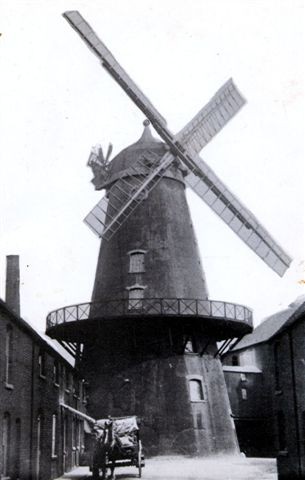
New Dock Mill
at Portsmouth
A short
extract from HMG archives by Tony Yoward
Dock
Mill was built by the Dockyard Co-operative Mill
Society in 1816, and the following year
contracts were offered for building Bakehouse,
store, engine house, dwelling houses, stable,
carthouse, etc. It was the last windmill to
be built on Portsea Island.
Dock Society’s Mill, Brick tower,
100ft high, 40ft diameter at the base, tarred,
with a domed cap, patent sails and fantail.
The Army Board of Ordnance supplied a million
bricks and all were used in the building. The
cap had a statue as the finial. A seven storey
mill with a gallery around the second floor,
it was built to provide cheaper flour at a time
when flour and bread was very expensive
It was put up for auction in
1922 and, not being sold, was demolished the
following year.
Monica Ellis’s publication on
Hampshire mills in 1978 stated that there is now
no trace of the mill and the block of flats
occupying the mill site is named “Moulin
Court”. The associated mill cottages were
renovated in 1971 and a plaque on these cottages
gives details of the mill.
|
 |
An article from the River Wey Trust Newsletter,
October 2009, of which HMG is a member
A VERY CONCISE HISTORY OF
WATERMEADOWS
A water meadow is an area of pasture within a
river valley that is
purposely flooded to encourage the growth of
grass. A continual flow of
water is brought from the river across a meadow
through a series of
channels known as carriers. These are allowed to
overspill. Water eventually flows into other
channels (drains) and is carried away and
back into the river or into another system of
carriers in another meadow
downstream. The flow of water is controlled by
sluices and hatches.
The water deposits nutrients which encourage
better grass growth. The running water insulates
the ground
keeping it warmer so that there is very early
grass growth in the
spring. This means that cattle can
graze earlier and two crops of hay
can be harvested each year.
The first documentary evidence
of a water meadow when land was deliberately
flooded dates from
1311 and is found in papers from
Bolton Priory in Yorkshire.
There is further documentary evidence of water
meadows in
Herefordshire at a later date and in 1669 John
Worlidge of Petersfield
wrote about water meadows describing them as
"One of the most
universal and advantageous improvements in
England" The water
meadow system became more elaborate in the next
few centuries. The
Wey water meadow system was probably constructed
in the 16th century or earlier. By the 18th
century sheep were grazed on the meadows by
day and were driven at night to the arable
fields where the manure
helped to improve the fertility of the soils.
The operation of these water meadows was
labour
intensive and there were dedicated "drowners"
who worked to keep the Channels of the water
meadows in good order. By the 19th and early
20th century the meadows were used for
grazing cattle. Eventually costly labour and
cheap fertilizers meant that the water meadows
were no longer economically viable and they
stopped being used.
|
An
Article from a newspaper dated 24 Jan 1974.
If this is your's we would be glad to hear from
you!
THE WATER MILLS OF
HAMPSHIRE
I
was interested to read an article on Alton’s Old
Mills, which recalled to my memory my somewhat
brief experience with the small millwright and
engineering firm of G. W. Cooper in Romsey.
I joined the firm in 1921 in
answer to an advertisement for a “fitter and
millwright”. To refer more specifically to my
work as a millwright, I first went with Mr
Cooper’s son to the picturesque mill at
Fittleworth, Sussex. I was only there for
three weeks when I was instructed to go to
Fareham Flour Mills. Then on another occasion
I was employed to make and install a water wheel
and pump at Quidhampton near Overton for the
making of “Treasury Notes” so they could have
the “R.Test” watermark.
I lodged in the home of one of
the “hand papermakers” at Overton. We moved on
to Kingsclere where we installed a “penstock”
and water turbine to supply electric power to
Kingsclere House the home of one of the Portal
family.
I have worked on dressing the
stones at Whitchurch, Itchen Abbas, a mill in
Salisbury connected with a cornstore business,
Sutton’s Mill Romsey and others. I fitted new
teeth to the main driving wheel at Wherwell;
these teeth were made of apple-wood. Then I
worked at what must have been the last water
mill to be built; at Bower or Broadchalk near
Salisbury.
I was sent to Eversley on the
Hampshire – Berkshire border; the address given
me was the New Mill, Eversley; when I found it I
learned that it was 300 years old.
Incidentally, there are three
kinds of mill-stones; the Derbyshire Peak for
general grist purposes, the French Burr
(cemented together n segments) for grinding
wheat and a carburundum type for bruising oats.
Incidentally, I helped to make a pair of the
carburundum stones.
Edward
C Dorey, Hiltingbury Road, Chandler’s Ford.
|
|
TIMBER TOUGHER THAN ENGLISH OAK
extract from the Times March 1966
Hornbeam, was known as the
engineer's timber, and has been used in mills for
over 200 years for cogs and pulleys.
In 1966, 300 hornbeam cogs were specified for the
gear wheels in the restoration of Chesterton
Windmill in Warwickshire.
Most hornbeam was imported from the continent, to be
used in piano action.
The timber is very strong and tough, being superior
in practically all strength grades to English oak.
The bending strength, stiffness, hardness, and shear
strength of hornbeam are 20 to 30 % higher than
those of English oak and its resistance to splitting
40 to 60 % higher.
It is a very heavy wood but has been largely
displaced by iron and sometimes lignum vitae.
Hornbeam is slow growing, and now mainly used for
garden hedges. However records show that Englands
tallest hornbeam was in Surrey, 105 foot high while
the stoutest, with a girth of over 17 foot, was in
Essex. |
Mills can be dangerous places as
shown by these two examples from the past by
Tony Yoward:
EAST MEON
SOUTH MILL
Hants
A
distressing occurrence is reported from East
Meon, Nr Petersfield. Mildred, the eight year
old daughter of Mr George Atkinson was in the
mill there with her brothers when one of them,
not realising that his sister was near the
shaft, started the machinery. The child’s hair
was caught in the shaft and she was killed. (The
Miller 6 Jan 1913)
BISHOPS
WALTHAM ABBEY MILL Hants
1877 Fatal accident in a flour mill. An
inquest was held on Saturday 3rd March on the
body of GEORGE SPARSHOT aged 72, employed at
Abbey Flour Mills, Bishops Waltham. He was
found dead in the wheel pit. GEORGE SOAL, the
miller, said he found the deceased entangled in
the wheel and near him were the oil mill and
candle, he evidently tried to oil the wheel,
from which he had taken the chain.
(The Miller 5 March 1877)
___________________________________________________________________
A DYING FRENCH
CUSTOM - La Minoterie
Along a small river near our house in France
there used to be three watermills. Many of us
are familiar with the French name for a miller -
meunier, but not all millers are known as
meuniers. The millers along the river had that
title, but one of the three was the local
minotier.
I
tried to obtain explanations for the different
names and the fact that one watermill processed
animal feed, the second processed woad, but the
third made the fine white flour used for bread
and cakes.
The coarse flour of the traditional country
bread was used to make `pain complet’, but to
obtain a `pain blanc’, the process came from
white flour from the minoterie. In local
parlance, the word minot is taken to mean fine
white flour.
I
believe the original word `minot’ is and ancient
French measure for three bushels (a bumpkin).
The tradition in farming areas was for a client
of the minotier to take sack of wheat weighing
81 kilos to the minoterie. That is eighty kilos
of wheat plus one for the sack - in patois, a
pocket of wheat.
The minotur gave the client a book of tickets (
a carnet) which gave the cllient the right to
exchange tickets to the value of 125 livres of
white bread when the minotier amde his delivery
round in the area. The client also received a
bag of son weighing 25 livres - a livre being
the equivalent of half a kilo. `Son’ is the
coarse part of the wheat which includes the bran
de son. The son was fed to the farm rabbits
and pigs.
The mathematicians among uswill have concluded
that 5 kilos of wheat are not accouted for.
They were the fee charged by the minotier to be
turned into bread for sale to the non-farming
members of the community.
The farming community never used money to pay
for their bread. The 85 year old grandmother
still complains that the minotier used a heavy
hand to bang the bread on the scales swiftly,
followed by his knife to take off a chunk of the
loaf, saying `too heavy’.
Jim and Ann
Knights
|
| |
|
|